
Unsure how much Search Engine Optimisation (SEO) services might cost for your website?
Aqueous Digital’s Founder and Managing Director, Jonathan Guy, explains all with this handy guide to SEO costs.
In the UK, monthly SEO costs will vary depending on the size of business and website, but on average, this is typically how much you should expect to pay in 2026:
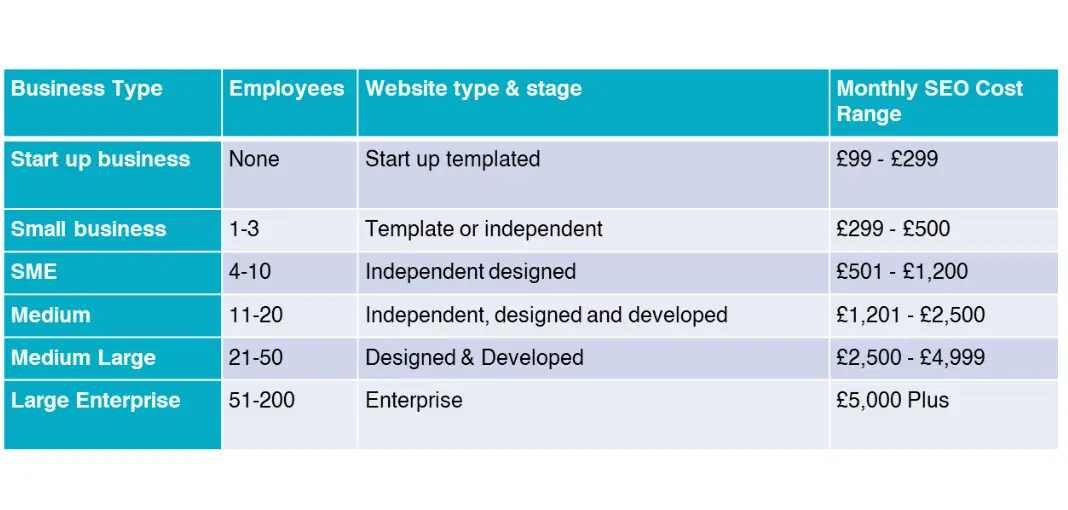
One of the most frequently asked questions about SEO is: ‘How much does it cost?’, yet nowhere online can you find a comprehensive answer to this question, nor any rationale behind the cost structure for this service.
Of course, the true answer to the question is: ‘How long is a piece of string?’.
Like asking a garage to tell you how much they will charge for repairing your car, before they know which car you have.
Or, like asking a travel agent to tell you how much it costs to go to Italy before telling them when, where, how and how many of you want to go.
The cost will always vary depending on exactly what you need. And, because SEO is still portrayed in certain quarters as something of a dark art, there is little transparency in pricing across the industry.

At this point, we tip our hats to Joshua Hardwick, Head of Content at Ahrefs, for not only conducting one of the best studies that has been done in this field, but for also making the raw data available for us to play with (thanks Joshua!) and to draw out articles like this.
This Ahrefs study – the largest survey of pricing in our industry – was carried out back in May 2018.
Ahrefs has since updated the results (in August 2024) to include 439 global respondents, and it makes for fascinating reading.
While the exact number of UK respondents isn’t stated, if we isolate the UK for the purposes of this article, we can use some figures to establish what people are charging for SEO.
However, this comprehensive study was last updated in 2024, so we must also account for various recent trends and their impact on UK SEO costs over the past couple of years, including the rise of AI (Artificial Intelligence) in Search, surging energy and fuel costs, and global supply chain disruption.
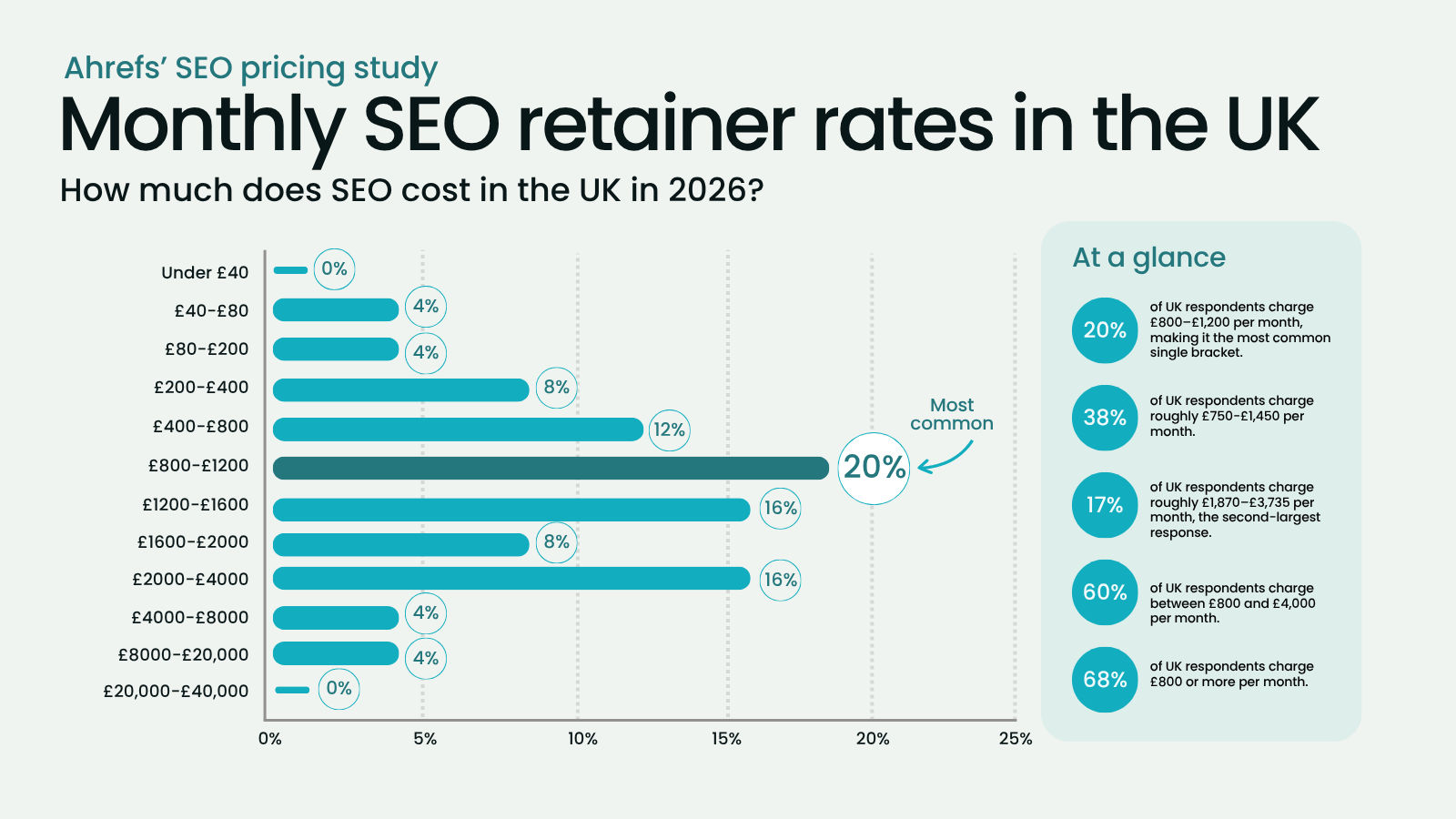
As the data suggests, most UK respondents (roughly 38%) were charging between £750-£1450 each month for their SEO services, with the second-largest response (around 17%) charging between £1870-£3735.
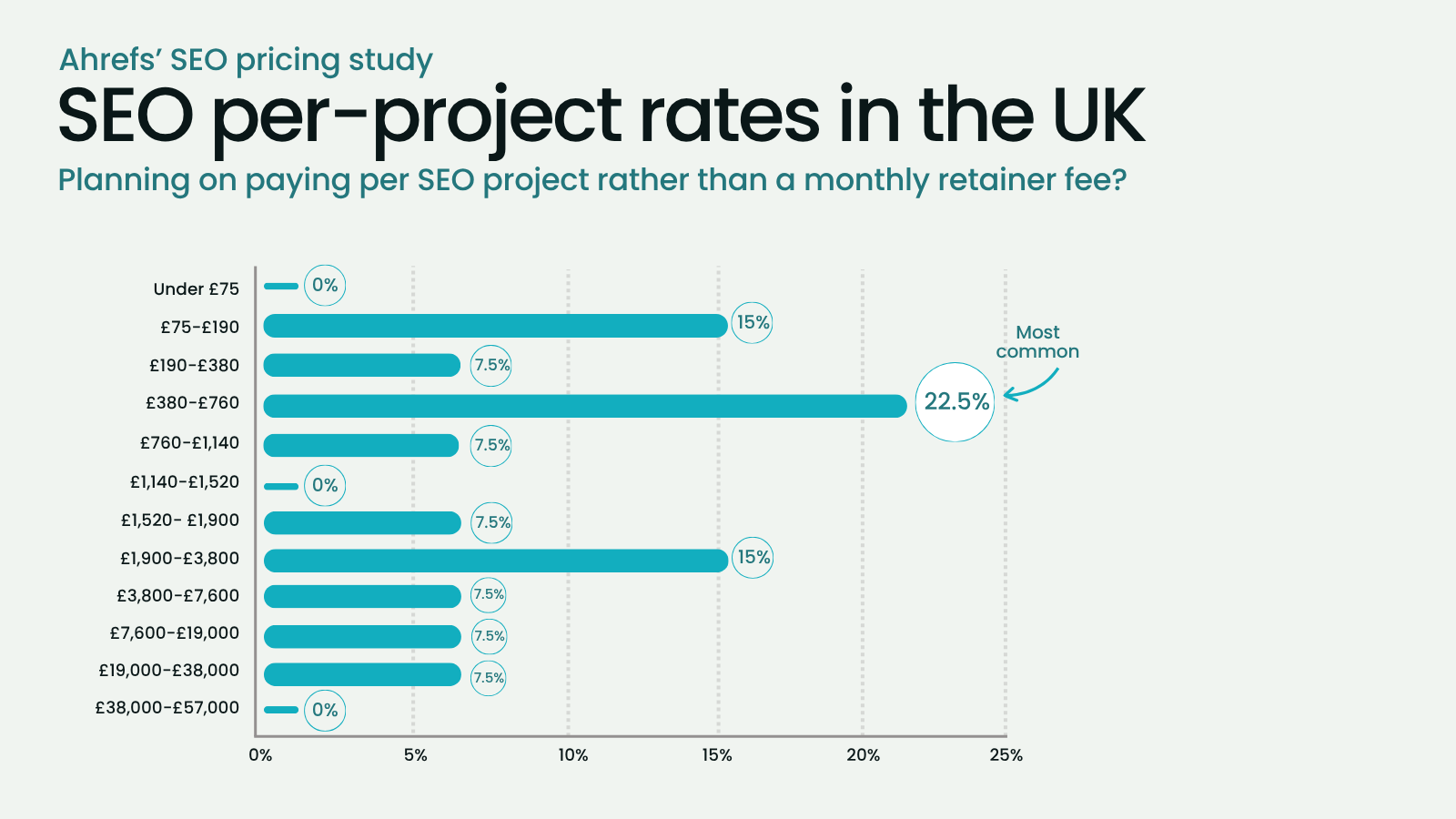
Planning on paying per SEO project rather than a monthly retainer fee?
SEO costs for this arrangement again vary wildly, but many UK respondents (around 23%) charge between £375 and £750.
UK SEO pricing therefore appears to be heavily influenced by the dominance of small businesses in the market – with some higher retainer figures targeted at supporting larger organisations with their SEO efforts.
With project-based fees commonly falling between £375 and £750 and monthly retainers clustering between £750 and £1,450, it seems many SEO providers are strategically pricing their services to align with the budgets and needs of SMEs, which make up over 99% of UK private sector businesses.
In fact, there are 5.45 million businesses in the UK that are classed as ‘small’, employing up to 49 employees.
These organisations tend to require ongoing SEO support but may not have the resources for enterprise-level retainers, creating a concentration of pricing in the lower-to-mid market range.
While not UK-specific, the breakdown used by Joshua in his survey also distinguishes SEO costs based on the different types of provider; agencies, consultants, and freelancers.
Interestingly, there is no clear definition within the article on what constitutes each of these groupings and in the case of an agency, that’s fine as it’s easy to define.
The difference between a freelancer and a consultant however is slightly more nebulous, but for the purposes of this article let’s assume that a freelancer is someone who does the same as an SEO agency, but on a smaller scale, usually as a one-person operation but sometimes with one or more person helping them.
A consultant is someone with significantly more experience in the field of SEO, who is happy to work alone on an hourly rate and a project basis but on larger projects and websites.
Depending on the type of SEO being carried out, the pricing model will vary accordingly. Hourly Rates, Monthly Rates and Retainer Fees three most frequently used pricing models in the UK.
For example:

Disclaimer: A quick word of warning about the above figures; the small data sample means that not everything here is as black and white as it seems. The figures skew slightly because of the small sample base, but they nevertheless give some interesting insight into SEO costs.
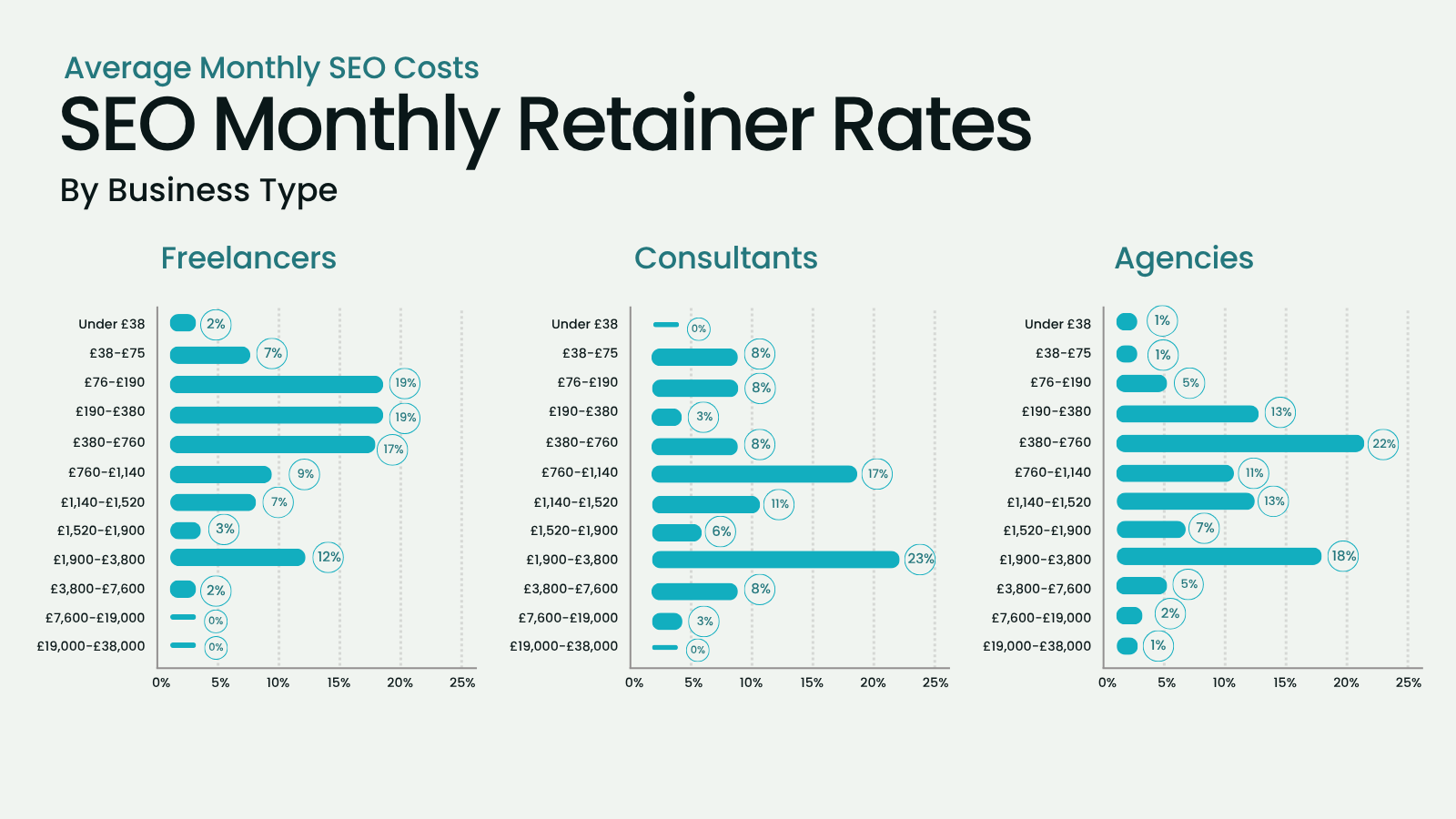
As you can see, freelancers typically charge less than both consultants and agencies, and from the raw data we can also see that consultants tend to be more selective with their customers, typically working alone and with fewer than 10 customers at any one time.
Freelancers, however, typically handle more customers and in doing so, still mostly manage this without employing staff.
They’re usually able to do this by making good use of automation, clear project definition, and keeping fees low for their customers.
Often, the data shows that freelancers charge lower rates overall than most agencies, and this is in line with what we hear anecdotally in the UK marketplace.
And that brings us neatly to how much you should be paying for SEO.
There is a very old saying in business, which is ‘you get what you pay for’ and in most cases, this adage holds true.
Nobody likes to pay too much for anything, but lots of us have been caught in the past by paying for something which seems cheap but turns out to be not what we needed or more expensive in the long run.
So, we don’t want to pay too much, but we do want to get value for money for whatever we buy.
And this leads us to what you are buying.
We’ve studied many other SEO rate cards over the past 10 years and to date, we’ve never found two which are the same.
No one agency, freelancer or consultant seems to offer the same service as another and that makes price comparison incredibly hard to do.
What most businesses buying SEO tend to do is decide what they think is the right amount, based on talking to a few agencies and then fixing on a price they think sounds about right.
As we can see from the tables above, charging rates vary depending on who you are using and the amount of work you will get from each of these will vary.
Typically, if you pay £500 to an agency, you won’t get as much as you would paying £500 to a freelancer.
The reason for this is simple; the freelancers have lower overheads, so more of what you give them can go into the work they do rather than paying bills.
Of course, it could also go towards paying them a bigger salary; you can never be sure as no two services are alike.
What might sound like a good service can be cheap and automated. This is where due diligence comes in.
In terms of what you should pay therefore, there seem to be two key variables in this equation which are;
Business needs are critical. We work with a wide range of businesses, and we have found that it’s not price that matters when buying SEO, it’s getting something that matches your needs.
As an example, if your website is technically poor, there’s not much point in driving lots more traffic to it as no one is going to convert.
While we may have done our job well (more traffic), if this doesn’t result in more business then the work is pointless.
SEO work falls broadly into three categories which are:
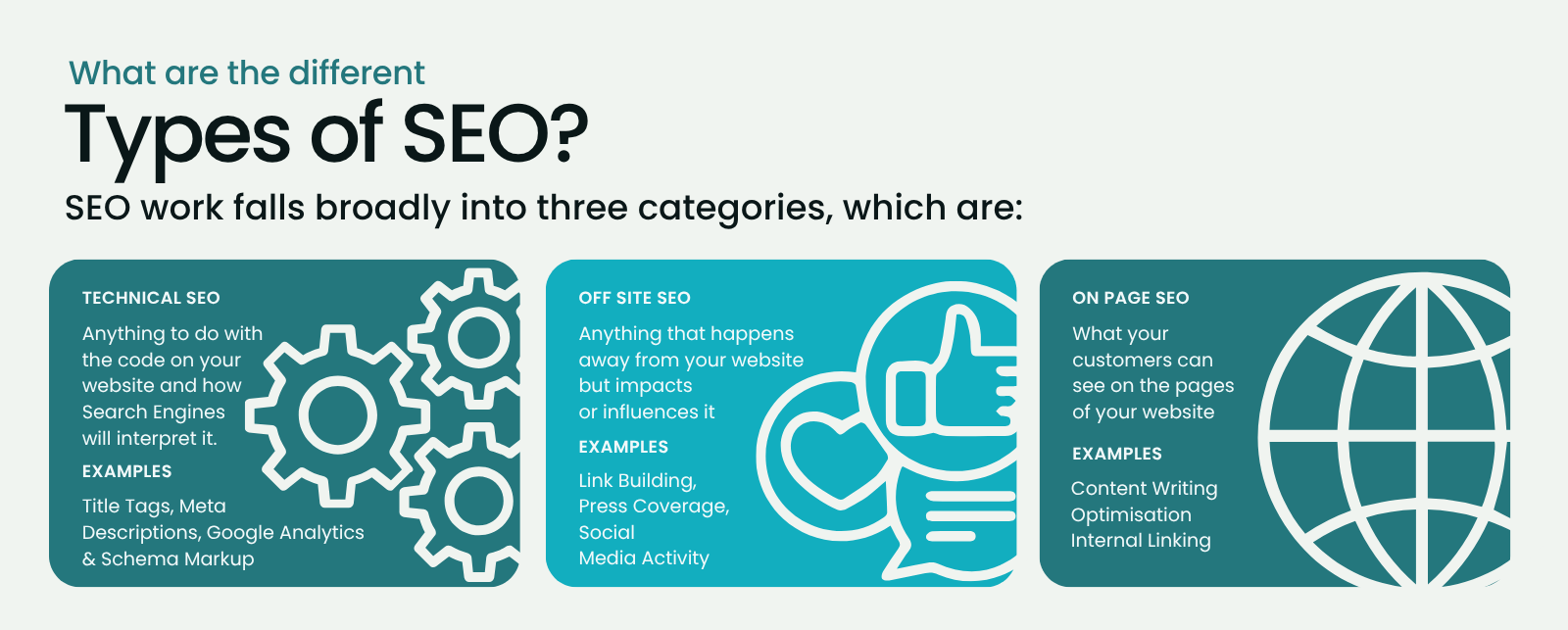
What you are buying is typically a mix of these three elements but which elements and in what proportions will vary depending on the person doing the SEO.
All of which means that getting a straightforward comparison is hard.
But with 15 years of experience behind us, we can offer the following as an outline guide to how much you should pay for SEO.

To explain this a bit further, many smaller businesses in the UK are home-based or a sole owner proprietor and where this is the case most of them will fall into the first two categories above.
The type of SEO you need if you have a templated website from someone like Go Daddy or Wix is restricted by what you can change, which technically, on one of these frameworks, is very little.
All you can really do is add content and link build.
By the time you get to an independent website framework, such as WordPress, the freedom to make changes increases so, Technical SEO becomes more important, as does the content.
As your business gets bigger, the website sophistication typically increases which brings with it more technical issues and challenges, along with the problem of content organisation.
Here, paying for a good SEO is worth their weight in gold!
Different SEO firms have different ideas on contract length, and in some cases, on whether they need a contract at all.
We know perfectly good freelancers that work on a rolling monthly contract but often, they find they get their fingers burned by customers dropping them at a moment’s notice.
Most agencies, however, will ask for a contract, with the most typical duration being one year, though some will do shorter timescales.
The reason for this is inherent in the work everyone does; if you are doing SEO properly and completely above board then it’s not easy and it takes time.
Typically, we will tell new customers that after three months the only thing they will know is whether they like working with us, after six months they’ll start to see the dials moving.
After 12 months, they’ll know why they chose to use us for SEO.
Of course, there are exceptions to the rule.
We have had customers who have jumped to number one for the keyword they want in a matter of weeks and others, who have seen the success after the year contract is up.
And that’s because it’s not a simple linear model. You can’t just ‘do a bit of SEO’ and expect to see results overnight.
SEO is about optimising your website for the search engines and – as Google makes upwards of six changes to its algorithm every day – keeping on top of that is an incredibly hard job.
I have been known to liken it to trying to herd cats, in the dark, in fog, with a blindfold on.
Much of the work we do in SEO is forward-thinking, and generating the right content and links requires time.
As an example, this article has taken over 30 hours to compile and if you were to commission a copywriter to do this it would be costly and take time.
Similarly with link building, reaching out to people who may link to your website takes time and effort but if done correctly, will drive long-lasting benefits.
But it doesn’t happen overnight.
SEO contracts therefore need to reflect the time and effort put in by anyone doing the work, and they also need to reflect that fact that much of the work we start on day one may come to fruition later down the line.
This explains why every SEO business needs notice to end a contract as content and links may be ‘in the pipeline’ and cannot be stopped.
In our experience, we find that the following graphic explains typical contract lengths for the different SEO providers in the UK:

Whichever you choose for your SEO, you should always remember that like you, no one likes losing customers.
If you’re deciding to make a change or move away, you should always give a reasonable notice period to allow them to unwind the work they have in progress.
One of the questions people struggle with is what drives pricing in the SEO market, after all, if we are all doing the same basic work it should cost the same, right?
As with most industries, the drivers of SEO costs vary wildly depending on what you are buying.
In the legal market for instance, when you engage a solicitor to work for you, they will typically send you a letter of engagement and in there will be the costs they charge for each of their staff members; associates, paralegals, solicitors and senior staff.
Rates vary enormously across these and depending on their specialism, the top rates can be more than £1,000 an hour.
They use this pricing structure because some of the work you need can be done by junior staff, but other parts need more senior or qualified staff to complete.
In SEO agencies, typically you will find they apply a blended rate because there are so many different staff members it would be hard to break each of them out and charge accordingly.
Billing would be a nightmare.
It’s far simpler to charge a fixed monthly amount to a customer and then worry about the split of the billing, and profitability, internally.
Aside from the cost of staff members, which you might expect will naturally vary depending on skills, qualifications and experience, there are other more obvious costs which need to be factored in.
The table below gives you a broad outline of the type of costs that each type of business will have to carry, which will, of course, reflect in their pricing.

Naturally, the table above is not a definitive list but is a good guideline to the type and scale of costs encountered by each type of SEO business.
Which then brings us to the obvious question of why engage a more expensive agency if the freelancers and contractors can do it at a lower cost?
When you’re looking online, you may find some rate cards publicly available.
However, what they all tend to do is to provide the classic ‘column of options’ with the promise that the more you pay, the more you get.
However, paying an SEO provider more for your SEO is not simply a question of giving them more money for the same service.
If you are in the South East of England you may find that firms locally charge more than the equivalent forms in the North West or North East.
This is not because they are necessarily better, or that you are getting more for your money, but because their base costs are higher.
Rents, rates, and office costs are much higher in London and the South East, meaning you may end up paying more for the service.
Similarly, freelancers and consultants typically charge less than agencies, not because they do a worse job, but because their cost base is lower.
Lower overheads mean lower costs and that can be passed onto customers in the form of lower prices.
But each service has its limitations as smaller firms cannot necessarily supply the same level of cover or service as larger firms.

It’s also worth noting that there are many agencies out there, who will claim to be ‘full service’ and jack of all trades.
In our experience, this is very rarely the case. They will generally have strong skill sets in some areas, but weaker delivery in other areas.
They will claim to be able to deliver all services from design, web development through to social media, programmatic advertising, PPC and SEO, but in reality they will be subcontracting some services without your knowledge.
It’s therefore recommended that you carefully assess the advantages and disadvantages of working with a ‘full service’ agency over those of a specialist SEO agency whose primary skill set will be in search.
Of course, on top of this are other areas such as social media and Google My Business optimisation, for which some firms will charge separately, but most of the work you need is within the three core categories.
Often, SEO packages will include things like keyword tracking and then limit the number of keywords they track at the lower end, increasing as you go up the scale.
Typically, you’ll find they limit the amount of work they do on, for example, meta descriptions, with increasing numbers available as the price increases.
Frankly, this approach is nonsense.
If your website has 500 meta descriptions that need writing, there’s no point in buying a package that limits the amount they will do as it won’t help your website.
Also, once a meta description or title tag has been written they typically don’t need to be changed, certainly not on a frequent basis, so as this is typically one-off work, why is it limited on the rate card?
A good SEO package should include three key elements.
In their regular study of Search Engine Ranking Factors, MOZ identifies these elements in order of importance – links, content and technical set up; so in order they rank;
Often, however, you will find other elements added to rate cards including things like Google Penalty Protection and Optimising Customer reviews but frankly, these should not be part of your decision-making process.
If an SEO firm is doing the job correctly, you won’t ever get a penalty (none of our customers ever has from the work we have done over the past 15 years) and when it comes to people leaving reviews, you can’t change them, only manage them, and that’s a separate service called Reputation Management.
So, when you’re choosing which firm to use, get an understanding of the type of work they intend to do for you and in what quantity, as this will make a huge difference to the outcome for your business.
Guarantees of success and number one positions are simply advertising techniques and firms use them as headlines to get your attention.
Some firms will tell you how many thousand number one keywords they have achieved for their customers, but a cursory glance will tell you that getting to number one for ‘blue widget manufacturers in Wimborne’ is not that hard.
Given that search engines update their algorithms daily, competitors can appear overnight and changes in the market can make your products more (or less) desirable, any promises of number one positions should be treated with caution.
There is, of course, a way of getting to number one, but it takes time, particularly on the harder keywords, and it takes a clear plan, well executed using the very best in SEO techniques for it to be sustainable.
As we said at the start, with SEO, typically, you get what you pay for.
Some firms are better than others but finding which they are can be a challenge.
If you’re searching for an SEO company to help your business then start by looking for someone who meets your current stage of business development.
All these questions, and more, are important when choosing.
Once you’ve decided on the type of firm you want to work with then we hope that the information and tables above give you an idea of the type of SEO costs you are likely to be asked to pay.
Want to find out more about Aqueous Digital and our range of complete SEO packages, starting at just £1,000 +VAT per month?
Depending on your specific needs, we have a range of SEO options to suit most growing businesses.
Arrange your free, no-obligation consultation and website audit today by simply calling us on 0800 285 1424 or emailing us at hello@aqueous-digital.co.uk.
We also offer SEO consultancy, technical SEO, and digital PR services – we’d love to hear from you to discuss how we can best support the success of your business.